Showing posts with label Abortion. Show all posts

Parents should be informed about the impact of Down’s Syndrome on families

The recent debate on abortion for anencephaly in Northern Ireland has reopened the wider debate on abortion for fetal disability.

It is worth, in this context, remaking the point that the most common disability for which babies are aborted in the UK is not anencephaly but Down's syndrome (DS).

This is usually on the basis of the perceived burden that children with DS will impose on families and the belief that the lives of disabled children are somehow not worth living. Is this justified?

Brian Skotko, a clinical fellow in genetics at Children’s Hospital Boston, published a series of three studies in the American Journal of Medical Geneticsin 2011 on the impact children with Down’s syndrome have on families (these have been previously covered on the CMF blog here and here and in this submission).

‘So many American women’ he says, ‘are getting prenatal diagnoses of Down's syndrome, and asking: “What does this mean for my family? What does this diagnosis mean for my marriage? What impact will it have on my other sons and daughters?” 

The results are incredibly revealing.

In his first study , 822 brothers and sisters were asked about their feelings and perceptions toward their sibling with Down's syndrome (DS).

More than 96% of brothers/sisters who responded to the survey indicated that they had affection toward their sibling with DS; and 94% of older siblings expressed feelings of pride. Less than 10% felt embarrassed, and less than 5% expressed a desire to trade their sibling in for another brother or sister without DS.

Among older siblings, 88% felt that they were better people because of their siblings with DS, and more than 90% planned to remain involved in their sibling's lives as they became adults. The vast majority of brothers and sisters described their relationship with their sibling with DS as positive and enhancing.

In the second study parents of children with Down's syndrome (DS) were asked how they felt about their lives. Of the 2,044 respondents, 99% reported that they loved their son or daughter; 97% were proud of them; 79% felt their outlook on life was more positive because of them; 5% felt embarrassed by them; and 4% regretted having them.

The overwhelming majority of parents surveyed reported that they were happy with their decision to have their child with DS and indicated that their sons and daughters were great sources of love and pride.

But the third study was most interesting of all as it explored the self-perceptions of children with Down’s syndrome.

Of 284 people with Down's syndrome (DS), ages 12 and older who were surveyed, nearly 99% indicated that they were happy with their lives, 97% liked who they were, and 96% liked how they looked.

Nearly 99% people with DS expressed love for their families, and 97% liked their brothers and sisters. A small percentage expressed sadness about their life.

Rebecca Taylor, writing about this research for Life News when it was first published in 2011, suggested that doctors should give the news of a Down Syndrome diagnosis with a smile saying, ‘There will be challenges but your child is nearly guaranteed to be a happy adult!’

In Britain, where abortion is permitted for fetal disability right up until birth, there were 3,968 Down’s syndrome babies aborted over the period 2002-2010 although the real number may actually be twice as high. Over 90% of all babies found to have Down’s syndrome before birth have their lives ended in this way.

One wonders what their parents were told (watch this video).

Fiona Bruce MP held a parliamentary inquiry into abortion for disability earlier this year, the findings of which were published in July.

One of its main conclusions was:

‘It should be best practice that parents are provided with practical and balanced information as soon as possible after discovery of a fetal disability and before leaving hospital so that they can make an informed choice. This should include leaflets or other information written by relevant disability groups. Parents should be offered contact with families with a child with a similar diagnosis without delay’

The quicker this recommendation is implemented the better.

There is no doubt that bringing up a child with special needs involves challenges, and yet at the very heart of the Christian gospel is the Lord Jesus who chose to lay down his life to meet our own ‘special needs’. The Apostle Paul tells us that Christ died for us ‘when we were powerless’ (Romans 5:6) and that ‘bearing one another's burdens’ is at the very heart of Christian morality (Galatians 6:1).

For Christian doctors bearing burdens involves not only providing the best medical care for the most vulnerable members of our society, but also supporting their families in the long haul, being prepared to speak out when they are being treated unjustly and doing what we can to oppose unjust and discriminatory legislation and health policy.

All of us are called in a whole variety of ways to engage in the fight for these very special people and others in a similar position of vulnerability. Let's pray that we fight these battles well.
You have read this article Abortion / down's syndrome with the title Abortion. You can bookmark this page URL https://celebrityunitedking.blogspot.com/2013/10/parents-should-be-informed-about-impact.html. Thanks!

Psychological trauma after abortion for fetal disability – parents need to know the facts


The belief that parents and families will be damaged by having a disabled child, and that this damage can be limited through abortion, is almost unquestioned today.

This has been a major assumption accepted by many participants in the current debate on abortion for anencephaly in Northern Ireland, on which I have recently written

But does the medical literature bear this out?

The question is an important one to ask both for Northern Ireland and for the rest of UK where abortion for fetal disability is already legal up until the time of birth. 

Recent statistics showed that between 2002 and 2010 there were 17,983 abortions of disabled babies in Britain. The overwhelming majority of these were for conditions compatible with life outside the womb and 1,189 babies were aborted after 24 weeks, the accepted age of viability.  

This 17,983 included abortions for serious disabilities like anencephaly but also babies with Down’s syndrome, cleft palate and club foot. 

Psychological trauma following abortion appears to be least when the pregnancy is early, when there is no maternal ambiguity about the decision and when the child was most definitely not wanted. 

Conversely psychological trauma is most marked with late, wanted pregnancies. 

As abortions for congenital abnormality usually occur in pregnancies that are both late and wanted, it is not surprising therefore that psychological morbidity is considerable. 

Psychological morbidity following termination of pregnancy for fetal disability is prevalent and persistent (1,2) and associated with long-lasting consequences for a substantial number of women (3).  

Rather than leading to psychological well-being, termination of pregnancy for fetal disability is an emotionally traumatic major life event which leads to severe posttraumatic stress response and intense grief reactions that are still detectable some years later (4). 

People do not easily ‘get over it’ although proper support during the loss can lessen psychological morbidity (5). In fact women who terminate pregnancies for fetal anomalies experience grief as intense as those who experience spontaneous perinatal loss with approximately a fifth developing major depression and/or requiring psychiatric intervention (6). 

Their families are also not immune with even very young children and those sheltered from knowledge of the event showing reactions to their parents’ distress and maternal absence (7). 

Some may experience an acute grief reaction or be plagued by guilt and fear that can precipitate marital breakdown. Additionally, there is a risk that through striving to eradicate congenital disability, a community risks promoting a cult of perfectionism that may have discriminatory effects on disabled people (8).

By contrast, current data on children and families affected by disabilities indicate that disability does not preclude a satisfying life. Many problems attributed to the existence of a disability actually stem from inadequate social arrangements that public health professionals should work to change (9). 

This, along with the psychological morbidity often accompanying abortion for fetal disability has led many to conclude that abortion for even severe fetal disability, as well as taking the life of a disabled person, is also worse for the parents and families concerned.

This is underlined by a case report in which a mother, against advice, chose to carry an eventually stillborn baby with anencephaly to term. It was found afterwards that she was ‘managing well and was more emotionally stable than the majority of women who underwent termination on genetic grounds’ (10).

Janet Goodall, a paediatrician with a lifetime’s experience of caring of severely disabled children, describes the ‘pearl effect’. 

In a culture that views success and failure in materialistic terms, many perceive disabled children as an extra burden. 

But paradoxically, divorce rates and unhappiness are no more common in the families of disabled children than in those with healthy children. 

Like the grit in the oyster that causes a pearl to form, caring for a child with special needs often strengthens relational bonds and encourages spiritual growth. 

As the agony of Gethsemane led to resurrection life, so the reciprocal love between the disabled child and his parents and the care shown by professionals, families and churches can act as a catalyst for maturity and stability.’(11) 

The Christian ethic, which calls the strong to make sacrifices for the weak, following Christ’s own example to us, leads to a strengthening of family and society, by combating discrimination and strengthening human virtues of patience, perseverance and altruism.

References


You have read this article Abortion / fetal disability with the title Abortion. You can bookmark this page URL https://celebrityunitedking.blogspot.com/2013/10/psychological-trauma-after-abortion-for.html. Thanks!

Defending the ‘indefensible’? Twenty reasons to think twice about aborting a baby with anencephaly

Note: This is a long post but the main points can be easily scanned. You can listen to my interview on the Stephen Nolan show on BBC Radio Ulster on this issue here

A woman who is carrying twin girls with a fatal foetal abnormality has appealed to the Northern Ireland Minister for Health Edwin Poots to allow her have an abortion in Northern Ireland.

The woman, known as Laura, who is almost 22 weeks pregnant, said she was very recently informed that her babies have anencephaly and had no chance of survival. She is now arranging to travel to England for an abortion.

The case of another Northern Ireland woman, Sarah Ewart, who had an abortion last week in London for a baby with the same condition at 20 weeks has recently been highlighted by the BBC’s Stephen Nolan.

The 1967 British Abortion Act does not apply in Northern Ireland, where termination is permitted only where it is ‘necessary to preserve the life of the woman or there is a risk of real and serious adverse effect on her physical or mental health, which is either long-term or permanent’.

Currently only about 40 abortions are performed in Northern Ireland each year although 905 women from the province had abortions in England Wales in 2012.

A consultation is currently taking place about changing the guidelines on abortion and Minister of Justice David Ford has saidthat there is a need to widen it ‘to look at difficult issues like foetal abnormality to see if where the law is currently drawn is in the right place’ (see also here).

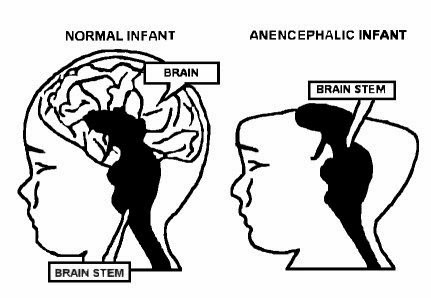
Anencephaly is a severe form of spina bifida where a failure of fusion of the neural rube in early pregnancy results in the baby developing without cerebral hemispheres, including the neocortex, which is responsible for cognition. The remaining brain tissue is often exposed, ie. not covered by bone or skin (see diagram above).

Those babies who survive to birth almost all die in the first hours or days after birth. There is no curative treatment available, only symptom relief.

Anencephaly is not uncommon, occurring in 1 out of 1,000 pregnancies, but only 3 out of 10,000 live births. Over 95% of parents opt for abortion in countries where this is legal and 208 babies with the condition were aborted in England and Wales in 2012. 

One cannot hear these tragic testimonies without being deeply moved by the emotions expressed. There are few things worse than losing a child and it is a huge thing for a mother to carry a baby to term, knowing that it will be born with a terrible deformity and die shortly afterwards.

It is perhaps not surprising therefore that the media coverage of these recent cases, along with the public reaction, has been overwhelmingly supportive of the decision to abort and that there is now growing pressure for a change in the law.

Very few people, even doctors or disabled people’s advocates, are willing to express a contrary opinion, and I do so only because I believe that the issue is so important that the arguments for the contrary position need to be heard.

Before I qualified as a doctor I probably would have taken the generally expressed view, but an experience I had as a junior doctor dramatically changed my attitudes both to disability and abortion.

More on that later, but first, at the risk of being accused of trying to defend the ‘indefensible’, let me give twenty reasons why I believe parents (and doctors) should think twice about aborting a baby with anencephaly, and why I believe we as a society should be advocating an alternative approach. I would stress that this is my sincerely held personal view.

1. A baby with anencephaly is a human being
Our humanity is not diminished or degraded by sickness, disability, fragility, intellectual impairment or by what people think of us or how they value us. Babies with severe conditions like anencephaly are human beings worthy, like all human beings, of profound wonder, empathy, respect and protection.

2. A baby with anencephaly is not brain dead
Babies with anencephaly, although not conscious, are not brain dead. Their brainstems are functioning at least in part which is why they can breathe without ventilators, often survive for several days and are  not permitted to be used as organ donors.

3. A baby with anencephaly is a dependent relative
Babies with anencephaly are profoundly dependent but are also biologically related to their parents and carry their genes. They are therefore dependent relatives and so should I believe be treated with the same love and respect as any other dependent and dying close relative.

4. A baby with anencephaly is a disabled person
Babies with anencephaly are profoundly disabled and have special needs. They are also people because personhood is not contingent upon intellectual capacity or function but conferred on every member of the human race. They are therefore just profoundly disabled people who should be treated the same as disabled people at any other age. There are other causes of similar brain dysfunction including birth asphyxia, trauma, stroke and brain tumour. 

5. Palliative care is the best response to terminal illness
Babies with anencephaly are human beings with a terminal condition. They are dying babies for whom no curative treatment is possible. The appropriate management in treating patients in this condition is palliative care – food, water, warmth, human company and symptom relief. Perinatal hospice is a wonderful concept that should be promoted much more widely. 

6. We should not be making judgements about the worth of other people 
None of us has right to make value judgements about the worth of another human being; especially when that person is unable to express an opinion about the matter. Equally we do not have the right to end their lives regardless of what burden we perceive they impose on us. 

7. Abortion for anencephaly is discriminatory
Anencephaly is usually diagnosed at the time of the 18 week anomaly scan so abortion is inevitably later than this. Most people however strongly oppose abortion beyond 20 weeks. The recent parliamentary inquiry into abortion for fetal disability (Bruce Inquiry) concluded that the current law on abortion for severe disability was discriminatory in two ways. First it allowed abortion up until 24 weeks for able-bodied babies but until birth (40 weeks) for disabled babies. Second it allowed abortion for babies with significant risk of a serious abnormality, but not for those with lesser degrees of special need. 

8. Abortion for anencephaly is often a coercive offer
The Bruce Inquiry revealed that there was a strong presumption from doctors that parents with disabled babies would choose to have them aborted. This led to a huge amount of subtle or direct pressure being placed on parents who decided not to abort. They were repeatedly asked to reconsider their decisions and treated like pariahs – in short they were discriminated against. It is just this sort of pressure that has led some commentators like Melinda Tankard Reist to talk about abortion for disability as a ‘coercive offer’. Reist’s book ‘Defiant Birth’ tells the personal stories of women who have resisted ‘medical eugenics’ and dared to challenge the utilitarian medical model and mindset.  

9. Abortion for anencephaly is contrary to every historic ethical code 
Historic codes of medical ethics such as the Hippocratic Oath and the Declaration of Geneva prohibit abortion. The latter states as one of its central tenets, ‘I will maintain the utmost respect for human life from the time of conception; even against threat I will not use my medical knowledge contrary to the laws of humanity’.

10. Abortion for anencephaly exchanges one problem for a whole set of different problems
Abortion may appear to offer a solution but the mother is still left to deal with the guilt, emotional trauma and unresolved grief of loss of what is almost always a wanted baby. These inward scars may take a lifetime to heal.

11. Saying goodbye properly is important for resolving grief and achieving closure
Achieving effective closure after the loss of a baby is best achieved if parents are able to spend time with their dying, or dead, baby, saying what they would have wanted to say and treasuring the precious moments. Covering the baby’s head with a woollen cap may enable them to focus on the eyes and face which are usually normal to look at (see the story of Rachel). ‘Saying Goodbye’ is a charity which is running very welcome thanksgiving services for couples who have lost babies before or after birth. 

12. Abortion for anencephaly can be profoundly damaging to a mother’s mental health
Mothers who abort babies for fetal abnormality are highly susceptible to mental health problems afterwards. This is because the abortions are late, the babies were generally ‘wanted’, an emotional bond with the baby has usually been established and there has been no opportunity properly to say goodbye. There is a better way than abortion.

13. Pregnancy is the most intimate form of hospitality
A mother’s womb offers protection, warmth, shelter, food and water within the body of one’s closest relative. There is no form of hospitality that is more intimate or more suited to one whose life is going to be very short.

14. There are real dangers of incremental extension once we embark down this route
The British Abortion Act 1967 was driven through on the back of the thalidomide disaster and was meant to authorise abortion only in severe circumstances. Now there are 200,000 abortions a year with one in five pregnancies ending in this way. Babies have been aborted for cleft palate and club feet. Recent statistics showed that between 2002 and 2010 there were 17,983 abortions of disabled babies in Britain. The overwhelming majority of these were for conditions compatible with life outside the womb and 1,189 babies were aborted after 24 weeks, the accepted age of viability. 

15. Deformity does not define us
Our worth as human beings is independent of any disabilities we might have.

16. Easing our own pain is not sufficient reason for ending another person’s life
Given that babies with anencephaly do not feel pain, the question has to be asked whose pain their deaths are actually relieving. Any interventions should primarily be aimed at benefiting the babies themselves.

17. Anencephaly forces us to acknowledge and face our deepest prejudices
In a society that values physical beauty, athletic prowess and intellectual capacity highly it is easy to see why babies with anencephaly are low down the pecking order. They fall foul of our deep societal prejudice toward people who are ‘ugly to look at’, ‘unintelligent’ and ‘physically inept’. The only effective way of overcoming such prejudices is to cultivate attitudes of compassion and care for people with severe disabilities. Caring collectively for those who are suffering, disabled and dying makes our society less selfish.  

18. Major life decisions should not be made at a time of crisis
Major life decisions, like choosing to abort one’s disabled baby, should not be made at a time of great emotional trauma. Parents need to be given the time, space and support necessary to make an unpressured and unhurried decision and need to be told that keeping the baby is an alternative option for which full support will be given.

19. We should not allow ourselves to be manipulated by the media or those with an agenda
I was deeply shocked that the BBC would interview a deeply traumatised grieving woman who had just heard the most devastating news of her life in front of a national audience just days before one of the most horrendous experiences a woman can go through – aborting her own baby. More than this, such hard cases should not be used by media presenters with a wider political agenda of liberalising abortion laws (see Melanie McDonough in the Spectator). This was I believe both exploitative and abusive. Huge sensitivity is also needed with the language we use. These are babies living with anencephaly. They are not ‘anencephalics’, ‘dead babies’ or ‘non-persons’. These are dehumanising terms. Just as we would not accept the terms ‘spastic’, ‘moron’, ‘imbecile’ or ‘vegetable’ to describe human beings, neither should we accept these.

20. Death is not the end
I have attempted to address the points above to a general audience but allow me one explicitly Christian argument. As a Christian I believe that human beings are made for eternity. This earthly existence is just the ‘Shadowlands’. So when we think of loved ones, who have died with dementia, we do not think of them as they were but as they will be. Because of Christ’s death and resurrection we look forward to the resurrection of the body into a world where there is no dying, mourning, death or pain. In this new world there will be no anencephaly. The Christian ethic is to treat all people as we would treat Christ and to treat others as Christ would have done. The bottom line is that we should treat babies with anencephaly as if they were Jesus himself, and treat them in the way he would have done.

I mentioned above an experience I had as a junior doctor which changed my attitudes to abortion and disability.

The administrative clerk on the medical ward where I was working was heavily pregnant and I asked her when she was due. She gave me the date and before I could say anything else said, ‘my baby has anencephaly’. While I was inwardly asking why she had not had an abortion, she added, ‘I could not bring myself to end the life of my own baby’.

The baby was born a few weeks later and survived about a week. She held it, nursed and cared for it and said her goodbyes before its inevitable death.

Up until that point I had not contemplated that such an approach was even possible. She not only demonstrated that it was but taught me a huge lesson about courage, compassion and how to face and handle tragedy, grief and bereavement. I have never forgotten it and resolved then, that if I was ever in the same situation I would want to do the same.

I have heard many similar testimonies since from women in similar situations who have made similar decisions and have become even more convinced that this is best way to handle it (See testimonies here, here, here, hereand here and resources for parents here).

Having a baby with a severe disability changes one’s life forever whatever choice one makes. But choosing to offer the hospitality of pregnancy and a mother’s care and compassion to a dependent and severely disabled relative, and to be willing to shoulder the inevitable pain of separation and bereavement, is I believe the best way through this tragic situation. 

Useful Links 

Testimonies 
A Life precious to God 
Waiting with Gabriel 
Baby Rachel's Legacy 
Love poured out is never wasted 
How to cope when you find your baby has special needs 
Our journey with anencephaly
Vapour and Mist - Sophia's story

Face book Groups 
Perinatal Hospice 
Waiting with Gabriel 
A Gift of Time
Anencephaly.info

Resources 
Perinatal Hospice 
Saying Goodbye
Links about anencephaly 
Defiant Birth
Anencephaly.info
NINDS Anencephaly information page 
Inquiry into Abortion on grounds of disability


You have read this article Abortion / anencephaly with the title Abortion. You can bookmark this page URL https://celebrityunitedking.blogspot.com/2013/10/defending-indefensible-twenty-reasons.html. Thanks!

DPP defers to doctors practising abortion on demand in failure to uphold the law

The Director of Public Prosecutions, Keir Starmer (pictured), said yesterday that he would not be prosecuting two doctors caught in a Telegraph sting who authorised abortions on grounds of sex selection.

The decision that a prosecution would not be in the public interest had previously fuelled massive outrage but Starmer claimed that in reaching his conclusion he ‘fully consulted with the police who agreed with him’.

In a detailed statement the DPP argued that ‘the law does not, in terms, expressly prohibit gender-specific abortions; rather it prohibits any abortion carried out without two medical practitioners having formed a view, in good faith, that the health risks of continuing with a pregnancy outweigh those of termination.’

‘On the facts of these cases, it would not be possible to prove that either doctor authorised an abortion on gender-specific grounds alone,’ he concluded.

In making his case to the attorney general who had sought ‘urgent clarification’ of the reasons, Starmer drew heavily on medical guidelines to justify his position.

He quoted the British Medical Association Handbook of Ethics and Law (2012) advising doctors that ‘there may be circumstances, in which termination of pregnancy on grounds of fetal sex would be lawful’.

Although he said this guidance was ‘far from clear’, it indicated the BMA’s view that ‘termination on the grounds of the gender of the foetus may be lawful if the effects of the pregnancy may be such that the continuance of the pregnancy would involve risk, greater than if the pregnancy were terminated, of injury to the physical or mental health of the pregnant woman or any existing children of her family’.

He also quoted an unnamed ‘Programme Manager at the Department of Health’ who ‘indicated that many doctors feel that forcing a woman to proceed with an unwanted pregnancy would cause considerable stress and anxiety.’

‘Procuring a miscarriage’ is an offence contrary to section 58 of the Offences Against the Person Act 1861.

However, section 1 of the Abortion Act 1967 provides that a person should not be guilty of an offence when a pregnancy is terminated by a registered medical practitioner if two registered medical practitioners are of the opinion, formed in good faith, inter alia, that ‘the pregnancy has not exceeded its 24th week and that the continuance of the pregnancy would involve risk, greater than if the pregnancy were terminated, of injury to the physical or mental health of the pregnant woman or any existing children of her family’.

Of the approximately 200,000 abortions which are carried out in Britain each year 98% are recorded as being on this basis and of these 99.96% of terminations are on the risk to the woman’s mental health alone.

As I have previously argued, these abortions are all technically illegal, as there is no sound medical evidence that continuing with a pregnancy ever constitutes a greater risk to a mother’s mental health than having an abortion.

But in practice the mental health clause is widely used by doctors, many of whom have not even seen the patient in question, as a convenient box to tick effectively to authorise abortion on demand.

Keir Starmer defended the initial decision of a CPS colleague not to prosecute in the two cases as ‘properly taken and sound’ and claimed that the law required prosecutors to prove that the doctors ‘did not carry out a sufficiently robust assessment’ of the health of the woman concerned before coming to their decision. 

He added that the ‘limited’ medical guidelines on the issue made this impossible and that it was now for others to decide whether these guidelines should be tightened.

The attorney general Dominic Grieve said he was satisfied that Mr Starmer had taken the decision ‘properly and conscientiously’ and that ‘it is for the DPP to make his decisions independently and based on the individual facts of the matter’.

Abortion is against every historic code of medical ethics including the Hippocratic Oath, the Declaration of Geneva and the International Code of medical Ethics. As recently as 1947 the BMA called it ‘the greatest crime’.

But doctors have now become abortion’s chief perpetrators and are been given a free hand to carry it out in Britain on an industrial scale without proper regulation and without fear of prosecution. There have been only a handful of prosecutions since the Abortion Act came into being 46 years ago.

So there we have it. The doctors betray their ethics and conspire to break the law on a massive scale.

The DPP lacks the balls to prosecute, defers to the doctors and passes the buck to parliament.

The police play poodle to the DPP. The attorney general washes his hands of the whole affair and parliament turns a blind eye.

Meanwhile over seven million future British citizens are sacrificed on the altar of political expediency. A law that is not upheld – or is perhaps even unenforceable - is no law at all.

What a sorry state of affairs.

I gather that David Burrowes MP has called for an urgent parliamentary debate on the matter tomorrow and intends to ask the attorney general a number of searching questions about how we reached this point.

I wish him every success. 
You have read this article Abortion / DPP with the title Abortion. You can bookmark this page URL https://celebrityunitedking.blogspot.com/2013/10/dpp-defers-to-doctors-practising.html. Thanks!

What people should know about the ‘once-a-month contraceptive pill’

The Guardian and other news outlets have highlighted a new journal article arguing that a ‘once-a-month contraceptive pill’ is ‘scientifically possible’.

Writing in the Journal of Family Planning and Reproductive Health Care, the researchers say such an advance would be welcomed by many women but the biggest hurdle to development is likely to be ‘political opposition’.

The new pill, they say, could be routinely used after, rather than before, sex. The idea would be that women wouldn’t have to take any precautions against pregnancy at all other than popping a pill whenever their period is delayed and they think they might possibly be pregnant.

What the Guardian doesn’t tell us is that such a pill would not be a ‘contraceptive’ (literally ‘against conception’) at all but rather an abortifacient (destroying an implanted human embryo). This is abortion and not contraception.

Nor does it tell us that a pill that acts in this way in the first few days after conception, ellaOne (ulipristal acetate), has already been available on prescription in the UK since 2009. Another similar drug, mifepristone (RU 486), is already used in Britain to procure medical abortions up to several weeks, but only under the auspices of the Abortion Act.

What is really being advocated is the deregulation of early abortion, by making it available over the counter. And there is no doubt that if such a move took place some women would stockpile the drugs and also use them in higher dose to procure their own later ‘do it yourself abortions’ at home. The thought of young girls disposing of their pregnancies at home – with all that might involve – is really quite horrifying. 

There are other huge dangers with such a strategy. British and American studies have already clearly demonstrated that  making emergency contraception available free over the counter without prescription leads to an increase in rates of sexually transmitted infections and does not decrease pregnancy or abortion rates. If this new pill were to be made available we would expect it to be at least as bad (see note on 'risk compensation below).

Britain already has the highest rate of teenage pregnancy in Western Europe.  Rates of sexually transmitted diseases are also rising. In 2009 there were 12,000 more cases than the previous year, when 470,701 cases were reported. The number of infections in 16-to 19 year-olds seen at genito-urinary medicine clinics rose from 46,856 in 2003 to 58,133 in 2007.

The availability of such pills would also expose women to greater risks of sexual abuse. The fact that one is not using contraception is a strong argument to avoid being coerced into having sex by a strong-willed boyfriend or someone wanting to cover up abuse. Having such a pill available for use by would-be abusers - ‘It doesn’t matter; if you miss a period you could just take this pill’ – actually makes women more vulnerable.

This latest ‘advice’ is not just another ill-conceived non evidence-based knee-jerk response to Britain’s spiralling epidemic of unplanned pregnancy, abortion and sexually transmitted disease. It is also an attempt to smuggle in even more abortion by the back door.

The best way to counter the epidemic of unplanned pregnancy and sexually transmitted disease is to promote real behaviour change. The government would be well advised to enter into dialogue with leaders of communities in Britain where rates of sexually transmitted diseases and unplanned pregnancy are very low, especially Christian faith communities, to learn about what actually works.

Note on risk compensation 

The phenomenon whereby applying a prevention measure results in an increase in the very thing it is trying to prevent is known as ‘risk compensation’. The term has been applied to the fact that the wearing of seatbelts does not decrease the level of some forms of road traffic injuries since drivers are thereby encouraged to drive more recklessly.

In the same way it has been argued that making condoms readily available actually increases rather than decreases rates of pregnancy and sexually transmitted infections because condoms encourage teenagers to take more sexual risks in the false belief that they will not suffer harm.

But whilst condoms offer some protection against sexually transmitted infections the morning-after pill offers absolutely none. Rather it encourages more risky behaviour in the false belief that one is safe.

Other blogs on related issues

What economics can tell us about teen pregnancy rates 
School contraceptives to 13 year olds 
Three false presuppositions about teenage pregnancies 


You have read this article Abortion / Contraception / Guardian with the title Abortion. You can bookmark this page URL https://celebrityunitedking.blogspot.com/2013/09/what-people-should-know-about-once.html. Thanks!

Outrage over failure to prosecute doctors for sex selection abortions reaches new heights

It has not been an easy two weeks for Keir Starmer (pictured), the Director of Public Prosecutions (DPP).

When it emerged on 4 September that the Crown Prosecution Service, which he heads, would not be bringing charges against two doctors who had been caught authorising abortions purely on grounds of gender, the outrage was immediate.

Within hours the Health Secretary Jeremy Hunt said that sex selection abortions were ‘completely unacceptable’ and calledfor the Attorney General Dominic Grieve to seek an ‘urgent clarification’ about the decision.

The following day Lord Macdonald, the former DPP, described the decision as ‘very dubious’ and amounted to letting doctors ‘avoid criminal action’ because of their professional status - undermining the basic principle that ‘everyone is equal under the law’.

The CPS then made the situation worse by arguing that it was down to doctors to ‘interpret the law’ and that they had ‘wide discretion’ to assess whether a termination is legal or not. Although there was enough evidence to bring a prosecution it was not in the public interest to do so, they claimed. The matter was more appropriately a matter for the General Medical Council (GMC).

This led the GMC to distance itself from the CPS’s decision, insisting that, as a professional regulator, it should not be seen as a ‘substitute’ for the criminal justice system and is not there to ‘punish doctors’.

Emily Thornberry, Labour shadow attorney general, then wrote to the DPP to request an urgent review of the decision. She cut right to the heart of the issues at stake (full text here):

‘The GMC is a regulator and cannot bring criminal proceedings. The provisions of the Abortion Act 1967 are crystal clear. The conduct of abortions for reasons not stated in that Act is a criminal offence, not just a regulatory one. To decide not prosecute because a regulator can hear the matter instead is to disapply the law and undermine the will of Parliament.’

David Burrowes, a Tory member of the all-party parliamentary Pro-Life Group, then raised the issue in the Commons. He said: ‘There is urgent need for a statement to clarify whether the restrictions on choice in the Abortion Act are now meaningless.’

This led to the Prime Minister expressing concern in response to a parliamentary question from Tory MP Nadine Dorries.

Mr Cameron praised The Daily Telegraph for highlighting ‘this important case’ and said it was ‘absolutely right’ that the doctors could face ‘professional’ consequences.

This weekend 50 MPs supported the Health Secretary’s call for the matter to be urgently investigated.

In a letterto the Daily Telegraph they called the decision a ‘step back in the fight for gender equality’ and accused the DPP of usurping parliament’s role:

‘The decision by the CPS could lead to the conclusion that gender-specific abortion is merely a matter of professional misconduct rather than illegal. This is clearly unconstitutional as it is for Parliament to legislate to change the law, and it has occurred without recourse to Parliament. Safeguards in the 1967 Abortion Act need to be properly applied and enforced. Doctors are not above the law and the General Medical Council cannot be a substitute for the courts.’

Other critics have accused the DPP of ‘double standards’ over abortion laws and operating a policy ‘worthy of Alice in Wonderland’.

Last Friday the Christian Legal Centre saidit was preparing for a private prosecution against the two doctors.

‘We are preparing for a private prosecution or judicial review, but we may do both,’ said chief executive Andrea Williams. ‘We will not let the matter go.’

I was asked to commentand said to the Telegraph that if the CPS won’t do its job then concerned citizens will step in. The CPS was giving the message that people wanting sex-selective abortions should come to Britain and that if the law is not upheld it will be increasingly flouted by unscrupulous people.

By failing to act the DPP has signalled that Britain is open for business as far as sex selection abortions are concerned. 

I can’t ever recall any issue related to abortion uniting those across the political spectrum in the way this has done. It has brought prolife activists and prochoice feminist factions together in an extraordinary way resulting in Keir Starmer attracting the wrath of all sides.

Now all the heat is on the DPP to explain fully why he has not upheld the will of parliament. We are all waiting.
You have read this article Abortion / Keir Starmer with the title Abortion. You can bookmark this page URL https://celebrityunitedking.blogspot.com/2013/09/outrage-over-failure-to-prosecute.html. Thanks!

Eight facts most people don’t know about the physical and psychological consequences of abortion for women

Contrary to popular opinion abortion hurts women.

TheUnChoice.com is an evidence-based Elliot Institute campaign to raise awareness about unwanted abortions, post-abortion issues and maternal deaths and to provide help, hope and healing.

The US-based Elliot Institute  publishes research and educational materials and works as an advocate for women and men seeking post-abortion healing.

The following figures, referenced below from an Elliott Institute publication, are eight evidence-based facts about the consequences of abortion for women’ health.  I have, where possible linked the references to the original sources.

1. 31% of women having abortions report suffering physical health complications (1)

2. 10% of women having abortions suffer immediate, potentially life-threatening complications (2, 3, 4)

3. Women have a 65% higher risk of clinical depression following abortion vs. childbirth (5)

4. 65% of women suffer symptoms of Post-Traumatic Stress Disorder (PTSD) after abortion (1)

5. Women's death rates from various causes after abortion are 3.5 times higher than after giving birth  (6, 7)

6. Many women describe their experience as ‘a nightmare’, which can hardly equated with ‘choice’. 60% of women surveyed after abortion responded that: ’Part of me died’ (1)

7. Suicide rates among women who have abortions are six times higher than those who give birth (7, 8)

8. Abortion increases a woman's risk of future miscarriages by 60% (9)

References


3. Grimes and Cates, "Abortion: Methods and Complications", in Human Reproduction, 2nd ed., 796-813.


Note: Studies 6, 7 and 8 looked at death rates for an average for up to one year after the end of the pregnancy. Another study found that looked at suicide rates for up to eight years found that, compared to women who gave birth, women who had abortions had a 62% higher risk of death from all causes and a 2.5 times higher suicide rate. Source: DC Reardon et. al., “Deaths Associated With Pregnancy Outcome: A Record Linkage Study of Low Income Women,” Southern Medical Journal 95(8):834-41, Aug. 2002.


You have read this article Abortion with the title Abortion. You can bookmark this page URL https://celebrityunitedking.blogspot.com/2013/08/eight-facts-most-people-dont-know-about.html. Thanks!

Eight facts most people don’t know about women having abortions

Contrary to popular opinion a large proportion of abortions are either unwanted or coerced.

TheUnChoice.com is an evidence-based Elliot Institute campaign to raise awareness about unwanted abortions, post-abortion issues and maternal deaths and to provide help, hope and healing.

The US-based Elliot Institute was founded in 1988 to perform original research and education on the impact of abortion on women, men, siblings, and society. It publishes research and educational materials and works as an advocate for women and men seeking post-abortion healing.

The following figures, referenced below from an Elliott Institute publication, are eight evidence-based facts about the pressures women having abortions face.

1. 64% of women having abortions feel pressured by others into it by others (1)

2. The number one killer of pregnant women is homicide (2, 3)

3. 54% of women felt uncertain at the time of their abortion (1)

4. 52% of women felt rushed at the time of their abortion (1)

5. 67% of women received no counseling by the clinic or other service-providers who performed the abortion (1)

6. 84% of women felt they did not receive adequate counseling before their abortion (1)

7. 79% of women were not informed by the abortion provider about available alternatives (1)

8. If a teenager has had an abortion within the last six months she is six times more likely to commit suicide (4)

References


4. Garfinkel et al., “Stress, Depression and Suicide: A Study of Adolescents in Minnesota,” Responding to High Risk Youth (U. of Minnesota: Minnesota Extension Service, 1986).

You have read this article Abortion with the title Abortion. You can bookmark this page URL https://celebrityunitedking.blogspot.com/2013/08/eight-facts-most-people-dont-know-about_24.html. Thanks!

New study adds further fuel to debate about link between induced abortion and breast cancer

Is there a link between induced abortion and breast cancer?

Any such link has been hotly denied by official bodies but a new study has added further fuel to this ongoing controversy.

The Bangladesh study published in the Journal of Dhaka Medical College on risk factors for breast cancer, led by Dr Suraiya Jabeen, found a statistically significant 20.62-fold increased risk among women with abortion histories.

This is by far the highest risk elevation reported among 73 publishedabortion-breast cancer studies.

Professor Joel Brind, a professor at Baruch College, City University of New York who is an expert on the abortion-breast cancer link, has observed that women in Bangladesh have very traditional childbearing patterns that reduce breast cancer risk. He first explains why abortion might increase the risk of breast cancer:

‘First, it is universally accepted that having a child decreases a woman’s risk of breast cancer, because the maturation of the cells in the breast into milk-producing cells renders them less susceptible to becoming cancerous. Second, pregnancy hugely increases the number of breast cells vulnerable to cancer. A live birth provides enough time for these “progenitor cells” to differentiate into more mature, more cancer-resistant cells. Therefore, abortion leaves a woman’s breasts with more places for cancer to start than were there before the pregnancy began.’

He then goes on to explain why the relative risk in Bangladesh might be so high:

‘Why such a high relative risk? That’s because almost all women in Bengladesh get married and start having children before they are 21, and breast-feed all their children as well. Consequently, breast cancer has been almost unheard of in Bengladesh, until recently.’

Of 73 worldwide studies since 1957 (including this latest) on the association of induced abortion and subsequent development of breast cancer: 53 studies show an association, and 15 studies show no association. See specifics here.

And yet many official bodies continue to deny categorically any link between abortion and breast cancer.

The Royal College of Obstetricians and Gynaecologists in their 2011 review ‘The Care of Women requesting induced abortion’ (see full report and summary) stated with a heady degree of certainty:

‘5.10 Women should be informed that induced abortion is not associated with an increase in breast cancer risk.’

Their lengthier summary concludes as follows:

‘WHO has concluded that induced abortion does not increase breast cancer risk. Similarly, in a recent review of the evidence, ACOG concluded that ‘The relationship between induced abortion and the subsequent development of breast cancer has been the subject of a substantial amount of epidemiologic study. Early studies of the relationship between prior induced abortion and breast cancer risk were methodologically flawed. More rigorous recent studies demonstrate no causal relationship between induced abortion and a subsequent increase in breast cancer risk.’

There is an overview of existing studies on the American Association of American Prolife Obstetricians and Gynaecologists (see AAPLOG website). It summarises as follows:

‘The possibility of this association has been persistently and vigorously attacked and denied by the major medical groups in the country since l994. The ACOG and the NCI have been particularly strong in opposing any suggestion that there is an association. In so doing, they have taken certain liberties with their interpretation of the scientific literature. AAPLOG feels that these liberties lack basic fairness and balance in reaching their “no association” conclusion.’

It goes on to discuss why such a link might be biologically plausible:

‘There are two pregnancy related independent risk factors for breast cancer established in the medical literature:

The first is the protective effect of an early first full term pregnancy. The landmark study establishing this protective effect [MacMahon, et al, (1970) Bull WHO 43:209-221] is widely accepted in the medical world. Obviously, aborting a first pregnancy eliminates the protective effect against breast cancer for that woman.

The second independent risk factor for breast cancer is induced abortion. As of 2004, 41 studies had been published in the worldwide medical literature (including 16 American studies) reporting data on the risk of breast cancer among women with a history of induced abortion. 29 (70%) of these studies report increased risk. Thirteen of the 16 (81%) American studies report increased risk, 8 with statistical significance (at least 95% probability that the result is not due to chance) irrespective of age at first full-term pregnancy. The relative risk increase of the 41 studies combined is 30%. (Note: this means that among aborted women there would be a 30% increase in breast cancer cases over what would normally be expected).’

In a 2007 CMF File we summarised the available evidence as follows (see source for references):

‘Breast cancer rates have been rising in Europe and North America for several decades and are projected to rise further. There is evidence suggesting that having an abortion may increase a woman's risk of breast cancer in later life. A 1997 review that pooled 23 studies found that the risk increased by 30% but authors of a 2001 review have denied a link. There are clearly powerful vested interests on both sides of this debate and space precludes the necessary in-depth review. However, it is undisputed that a full term pregnancy protects against subsequent breast cancer, and that significantly preterm deliveries make it more likely. The link is therefore biologically plausible.

While it may be prudent to acknowledge that “the jury is out” with regard to a possible link between abortion and risk of subsequent breast cancer, further research is needed to conclude the debate. In the meantime, and in the interests of informed consent, every woman considering abortion should be offered as much information about the possible risks as she wishes.’

The issue has also been previously covered in the CMF Journal Triple Helix but not since 2003.

This is clearly a debate that will run and run and in which huge vested interests are involved.

In the meantime women should not be fobbed off with the unjustified absolutism of the summary sentence from the RCOG, as most presently are.

Rather they should be made aware that a link between abortion and breast cancer is biologically plausible but that the evidence is still hotly disputed by researchers, obstetricians and gynaecologists.  

You have read this article Abortion / breast cancer with the title Abortion. You can bookmark this page URL https://celebrityunitedking.blogspot.com/2013/08/new-study-adds-further-fuel-to-debate.html. Thanks!

Courageous MP thrown out of government for refusing to back legal abortion

Ireland's Europe minister quit last Thursday over plans to legalise abortion as Prime Minister Enda Kenny pressed ahead with legislation that has polarised the country.

Kenny has provoked a strong backlash by pushing for access to abortion when a woman threatens suicide, a move that opponents say could easily open the floodgates to abortion on demand.

Lucinda Creighton (pictured), once tipped as a possible leader of the Fine Gael party, was automatically expelled from its grouping in parliament for voting against an amendment to the new law and will now lose her role as minister for European affairs.

‘When it comes to something that is essentially a matter of life and death, I think it is not really possible to compromise,’ Creighton told state broadcaster RTE after the vote.

Ireland’s lower house of parliament passed the bill by 127 votes to 31 and acceptance in the upper house is considered by many now to be a formality.

Under the new bill abortions will be legal if ‘there is a real and substantial risk of loss of the woman’s life by way of suicide’ and if an abortion is the only way of averting the suicide. Three doctors must sign off on each case. No time limits are mentioned in the legislation.

Ms Creighton objected vehemently to this clause. She argued that it was unworkable and ‘has the potential to normalise suicidal ideation by enshrining suicide on our statute book for the first time’.

After the vote Ms Creighton said that she was very sad to be forced out of the party. But in a lengthy apologia, Ms Creighton told the Dail that she was not a ‘pro-life campaigner’ but that that abortion was not a ‘liberal’ cause. It was ‘a tool for the oppression of women’. She also disavowed a religious motivation for her principled stand:

‘There is an emerging consensus in Ireland which suggests that having a sense of morality has something to do with the Catholic Church…. This is deeply worrying. It is a lazy way of attempting to undermine the worth of an argument, without actually dealing with the substance. This is not just a Catholic issue, any more than it is a Protestant or Muslim issue. This is not a religious issue. It is a human rights issue… We all have the right to conscientious objection. It is enshrined in Article 18 of the United Nations, Universal Declaration on Human Rights.’

Martin Luther King Jr's argued in his influential ‘Letter from a Birmingham Jail’ - written 50 years ago in April 1963 – that conscience was the lodestar of an honourable man.

Professor John Wyatt has defended its use in medicine saying that ‘the right of conscience helps to preserve the moral integrity of the individual clinician, preserves the distinctive characteristics and reputation of medicine as a profession, acts as a safeguard against coercive state power, and provides protection from discrimination for those with minority ethical beliefs.’

But the right of conscientious objection is increasingly coming under attack from a number of prominent ethicists and writers. According to Oxford Professor Julian Savalescu, a prominent bioethicist:

'A doctor's conscience has little place in the delivery of modern medical care… If people are not prepared to offer legally permitted, efficient and beneficial care to a patient because it conflicts with their values, they should not be doctors’.

A recent article in the New England Journal of Medicine similarly stated:

'As the gate-keepers to medicine, physicians and other health care providers have an obligation to choose specialties that are not moral minefields for them. Do you have qualms about abortion, sterilization and birth control - do not practice women’s health.’  

As I have previously argued there is a strong biblical precedent for the exercise of conscience when governing authorities act to threaten innocent human life.

The Hebrew midwives when ordered by the king of Egypt to kill all male Hebrew children refused to do so and as a result we are told that God commended and rewarded them (Exodus 1:15-22).

Rahab the harlot similarly refused to co-operate with the king of Jericho in handing over the innocent Israelite spies (Joshua 2:1-14). She is later praised for her faith in so doing (Hebrews 11:31; Jas 2:25).

Moreover conscience was often exercised at great personal cost.

The prospect of death as a consequence of disobedience to state law did not stop Shadrach, Meshach and Abednego refusing to bow down to the image (Daniel 4:6-8), or Daniel persisting with public prayer (Daniel 6:1-10). They were defiant.

In the New Testament when Peter and John were commanded by the Jewish authorities not to preach the Gospel they replied,  'We must obey God rather than men' and went right on doing it (Acts 5:29).

As Ms Creighton has argued, abortion is not just an issue that concerns Christians.

It also runs counter to the Hippocratic Oath, the Declaration of Geneva, the International Code of Medical Ethics and the Universal Declaration of Human Rights. In fact the British Medical Association once called it ‘the greatest crime’.

Ms Creighton is to be commended for her courageous stand. What a shame that more did not stand with her. 
You have read this article Abortion / Conscientious Objection / ireland with the title Abortion. You can bookmark this page URL https://celebrityunitedking.blogspot.com/2013/07/courageous-mp-thrown-out-of-government.html. Thanks!